



Working principle of Immersion Level Transmitters
#news ·2025-12-10 20:16:56


Immersion Level Transmitters liquid level transmitter is the principle of liquid static pressure measurement or the principle of static water column pressure. This principle is based on a fundamental law of physics:
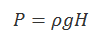
The static pressure at a point in a stationary liquid is proportional to the vertical height from that point to the liquid surface (i.e. liquid level depth), as well as to the density and gravitational acceleration of the liquid.
The mathematical expression is:
among which:
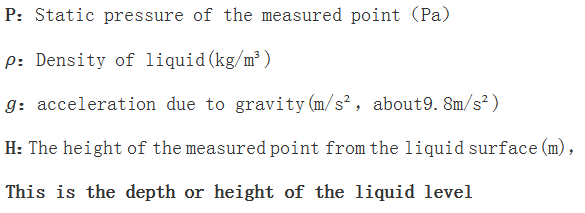
Calculate the liquid level height H:According to the principle formula ,The transmitter uses a preset liquid density ρ value and gravity acceleration g value internally to convert the measured static pressure P into the corresponding liquid level height H。
Key point: For transmitters directly used for liquid measurement, the pressure P in P=ρgH refers to the gauge pressure, which is measured relative to the atmospheric pressure at that time and place. This is because the back end (electrical part) of the transmitter usually has an air vent or air duct (air cable) to introduce atmospheric pressure to the sensor reference end, so that the sensor measures the liquid static pressure minus atmospheric pressure, directly reflecting the pressure of the liquid column (i.e. gauge pressure).
In summary, the static pressure P measured by the transmitter at the bottom of the liquid is essentially determined only by the height H and density ρ of the liquid column above it (under the premise of constant g). By accurately measuring P and converting it based on the known value of ρ, the liquid level height H can be obtained.